EXTEND THE LIFE OF GEOSYNTHETIC LINERS: Technical Paper delivered by K. R. Legge of
DWAF at the 8th ICG, Yokohama, Japan.
GO
ENHANCED BARRIER SYSTEM : Sardinia Paper: 1 of 3
This paper was presented in Sardinia, 2007 by K.R. Legge, P.A. Legg and P.J. Meyer.
To appreciate a coupled solution for heat-induced
degradation of contaminant barrier systems, we first need to remind ourselves of the problems associated with elevated temperatures in our fairly young science.
On this page : Slides 1 - 13
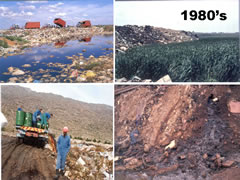
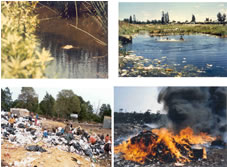
In the 1980’s, many countries were still depositing waste in an uncontrolled manner
for land reclamation and the like;
with the associated environmental consequences of both ground, water and air pollution.
Even hazardous waste was disposed in an inappropriate manner at times.
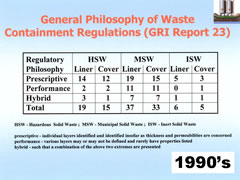
By the 1990’s, 37 countries had introduced regulatory requirements of either a
performance or prescriptive nature and, in some cases, a blend thereof.
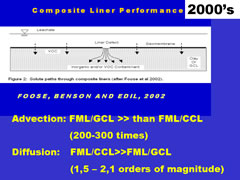
By the turn of the century, our industry had an appreciation of the superior performance
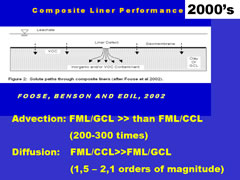
of composite geomembrane and GCL liners compared to composite geomembrane and compacted clay liners. This has been shown by both mathematical modelling as well as the
monitoring of performance of in-situ barriers.
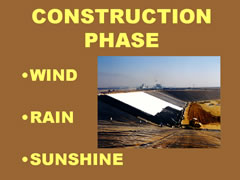
The climatic conditions during construction influence the variation in temperature and
need to be recognised as they have a medium and long-term effect on performance as well.
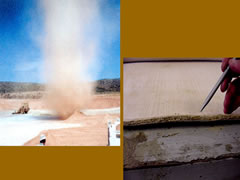
Wind can remove fine material from the interface of a clay and geomembrane liner during
construction and rainfall events both by very dry periods can induce desiccation cracking of GCL’s.
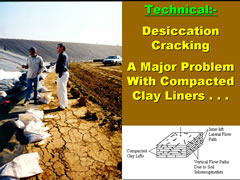
Sunshine and high temperatures beneath geomembranes can induce desiccation cracking of
the underlying natural clay components of liners to an alarming extent.
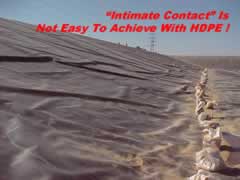
With geomembranes having relatively high coefficients of thermal expansion, the number of
wrinkles that appear within a liner can further reduce performance due to elevated temperatures during the construction phase.
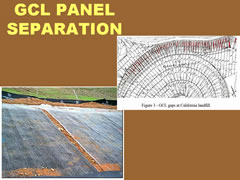
Other problems associated with varying temperature and moisture conditions include the
recently reported panel shrinkage of GCLs beneath geomembranes with limited or no normal load.
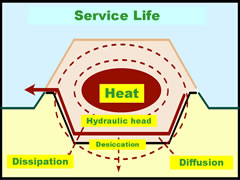
The service life conditions to which contaminant containment barriers are exposed are
represented diagrammatically showing heat being generated within the body of overlying waste due to biological degradation, chemical reactions or combinations thereof and, in some
cases, the introduction or deposition of waste at elevated temperatures. The consequences thereof include further desiccation of the underlying clay components of the barrier
system, degradation of the polymeric materials used, in particular, the geomembrane and an increase in the rate of diffusion of volatile organic compounds through even intact
barrier systems. All three of these heat-induced factors reduce the performance of the containment barrier system.
The extent to which temperatures rise within landfills is well documented in the
literature and we note that, in many instances, the barrier system is at temperatures above 40oC.