EXTEND THE LIFE OF GEOSYNTHETIC LINERS: Technical Paper delivered by K. R. Legge of
DWAF at the 8th ICG, Yokohama, Japan.
GO
ENHANCED BARRIER SYSTEM : Sardinia Paper: 2 of 3
This paper was presented in Sardinia in July 2007 by K.R. Legge, P.A. Legg
and P.J. Meyer.
On this page : Slides 14 - 25
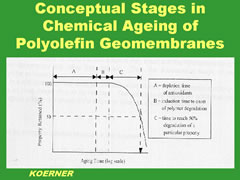
The method of degradation of a polymer membrane is well documented.
And the rate at which a high density polyethylene geomembrane will degrade has been
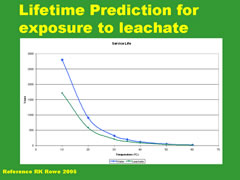
recorded in several recent publications. We should remind ourselves of the 2005 Rankine lecture which brought our attention to the even further reduction in service life of a
geomembrane at eleveated temperature and exposed to leachate. It has been argued that, in an anaerobic condition, there is insufficient oxygen to allow fur further oxidation
of a membrane. However, this does not recognise the free oxygen available beneath the geomembrane within the soil or clay components beneath the membrane.
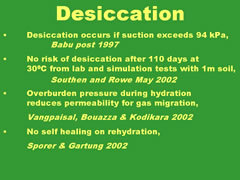
The extent of dessication cracking of clay components and barriers is commonly known; and
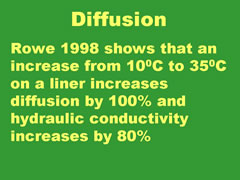
The significant increase in the rate of diffusive losses for relatively small increases
in temperature has been quantified.
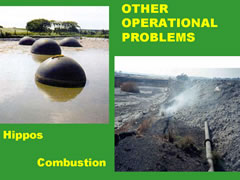
Other problems associated with service life include the build-up of gases beneath liner
systems and spontaneous combusion of landfills.
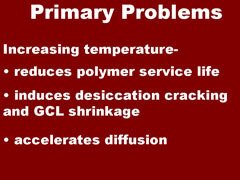
Thus we know that the primary problems associated with containment performance are
related to increased temperature which results in a reduced polymer service life, an increase in desiccation cracking and GCL shrinkage with consequent increase in advective
losses and accelerated diffusive losses.
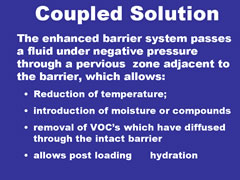
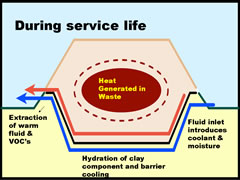
A coupled solution was thus proposed which makes use of the adjacent permeable drainage
layer or leak detection system to draw a fluid through under negative pressure, which would allow for the removal of diffused VOCs, the removal of heat so as to reduce the
temperature to which the barrier is exposed and the introduction of moisture to hydrate and maintain the clay component in hydrated condition.
This is shown schemtically in the diagram where the blue line represents the fluid drawn
through the pervious layer under a negative pressure.
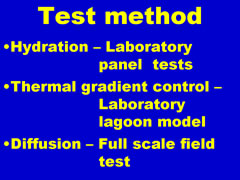
Three test series were undertaken to evaluate the performance of this coupled solution
comprising laboratory hydration and temperture tests and an in-situ fields tests on different management.
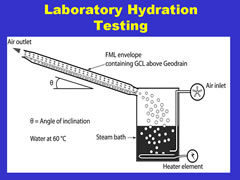
The hydration tests undertaken in the laboratory of the University of the Witwatersrand
comprised passing air through a water bath and then through an envelope of geosynthetic materials representing a typical primary composite liner with geosynthetic drainage layer
and underlying geomembrane.
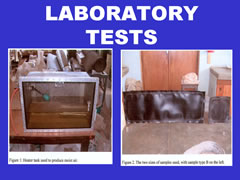
On the right hand side, the water bath can be seen and, on the left hand side, typical
geosynthetic envelopes representing statutory composite liner requirements.
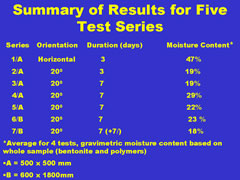
The results of these tests show a rapid increase in moisture content of the GCL layer
within the geomembrane envelope as the Bentomat absorbs moisture. Within a short period, the rate of moisture absorption reduces as the Bentomat swells reducing
permeabilty. Uniform distribution of moisture was noted over the length of the sample and the horizontal tests show the higher moisture absorption due to ponding within the
leak detection system of condensed water.